the vacation not taken:
magical kingdom
tribe wandering desert
unresolved issues
Zen Warrior:
dharma dilletante
mind, body awakening
taekwondo, really?
Wednesday, July 14, 2010
Bad Haiku Day

Sunday, January 31, 2010
Could it be?
I looked at my blog's site meter for the first time in ages this morning and saw that I had been visited by someone from a mythological locale:
Location Continent : North America
Country : United States (Facts)
State : Alaska
City : Wasilla
Lat/Long : 61.5235, -149.5748 (Map)
Distance : 3,373 miles
Could it really be her?
Wednesday, December 30, 2009
Christmas 2009: Wow, it really worked this time!
After numerous disasters (Christmas 2007, for example, was the worst day of my entire life), irritations, and disruptions, we finally had a Christmas go right. It went well enough that I no longer officially hate Christmas.
We drove up to Alexandria on the 23rd, set up our tiny hotel tree, and wrapped presents. We took out the boys one at a time on XMAS Eve, Adam first. They opened their presents, then went about their usual Alex routines with us. Next year, we'll take Toby out first. He was very upset when we got to Home Deopt and it was already closed. He took a HD book back to school with him a couple of weeks ago and had me draw a Home Depot, so I suspect he had built up a HD visit in his mind for a while. It crushed him when we couldn't do it. Everything should still be open in the morning next year. We repeated the routines on Christmas Day, though we could only take them to the hotel and not to any of their other places, all of which were closed. After we returned Toby to St. Mary's on XMAS Eve, DW and I bought pizzas for the overnight staff at St. Mary's, delievered the pizzas to the school, then drove to Natchitoches, Louisiana, for that town's spectacular lights display. They've been at it for 83 years, and it's quite a sight--and it's well worth a holiday visit to Louisiana. I'm just saying.


The Boy Tree at our house. I gathered up all of the plush toys we've taken from the claw machines at WalMart and used them as ornaments. The crowning touch is having Bat-Man serve as the star, a suggestion DW made.

The Girl Tree at our house. It's pretty and elegant, and DW added more color to it this year.

DW brought home a little WalMart one day, and shortly thereafter I became attracted to the WalMart Cowboy Christmas village and its saloon, outhouse, and windmill. I'd never put up a village before.

DW and I visited Celebration in the Oaks in New Orleans City Park this year. Major fail. The lights looked like they were purchased at WalMart or Target, and half of them didn't work anyway. Celebration in the Oaks used to be a big deal, with fabulous light displays and other seasonal junk. Now it's like a dinky county fair. So sad. Thankfully, we saw Avatar just before we went there, so the evening was a net gain.

My best seasonal photo of Toby has him choosing the perfect cereal on Christmas Eve. He bought Cookie Crisp, which I had to eat after he left it at the hotel.

Adam opened his own presents this year, for the first time ever. He usually could care less about them, but he kept a few for himself this time around.

Adam and I saw this unattended fire engine outside one of the local WalMarts during his post-holiday home visit. He had some fun with it. No, I didn't open the door and turn on the sirens and lights, but that doesn't mean I didn't want to.
Friday, September 18, 2009
Tuesday, September 15, 2009
Fools and Their Money
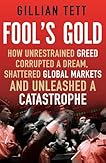 Fool's Gold: How Unrestrained Greed Corrupted a Dream, Shattered Global Markets and Unleashed a Catastrophe: How an Ingenious Tribe of Bankers Rewrote ... Made a Fortune and Survived a Catastrophe by Gillian Tett
My rating: 5 of 5 stars
I've done a fair amount of reading about the Panic of 2008, and Gillian Tett's "Fools Gold" explains the exotic investment instruments at the heart of the panic better than any other work I've read. A group of derivatives traders at J.P. Morgan created commoditized credit default swaps in the early 1990s as a way to move risk off the company's books, freeing up capital for lending and investment that otherwise would need to be held in reserve. Morgan made payments to AIG, which assumed the risk that Morgan's assets would go into default. Derivatives traders at other firms began assembling securities backed by subprime mortgages, trying to put together instruments that would be just risky enough to obtain returns but safe enough to obtain AAA ratings. They then paid AIG to assume the risk of the mortgages underlying those securities going bad. However, many institutions kept what they thought were the least risky of these mortgages on their own books, as they could not obtain much in the way of returns on the securities that they would back. The whole thing was unregulated by government, and the ratings agencies were easily bamboozled into turning poo into gold (as it turned out). As the cruddy mortgages went bad, AIG began to take on water. When the less risky mortgages went bad, the financial institutions themselves sank.
Interestingly, J.P. Morgan did not get into the business of mortgage backed securities. Morgan's mathematicians could not put together a risk model with the kind of integrity to which they were accustomed. First, they had no data on what could happen if real estate values ever declined. Second, they had no long-term data on default rates for the kinds of subprime mortgages that proliferated in the early and mid 2000s. Moreover, Morgan/Chase chairman Jamie Dimon pushed the concept of a "fortress balance sheet" containing rock-solid assets on which the bank could rely if things went to hell. Dimon pushed Morgan's derivatives traders to investigate getting into the business of mortgage backed securities a couple of times, but, consistent with the notion of a "fortress balance sheet," he accepted the traders' reasons for staying away from that business.
The book contains a brief account of the events leading to the Lehman Brothers bankruptcy that turned a situation into a panic, and concludes with Tett's cultural analysis of U.S. and U.K. investment houses.
View all my reviews >>
Monday, August 17, 2009
iGoogle Experiment
I discovered iGoogle yesterday, G's customizable home page. There is a gadget for blogger, so I placed one on my page. Also, I may move from hotmail to gmail, but I'm not sure about that one yet. The one advantage to gmail is that it will push e-mails instantaneously to my iPhone, instead of having to have them pulled via a third-party app. Also, I had to replace my Apple Mobile Me calendar with a Google calendar recently in order to sync my laptop and iPhone reliably (Mobile Me for Windows is ridiculously bad). Interestingly, Google uses Microsoft's Exchange servers for sync, while Microsoft itself will not use its own Exchange servers so its Hotmail and Windows Live subscribers can sync to their iPhones. Gotta love companies that don't play nice together.
Thursday, August 13, 2009
Mad World
Season Three of Mad Men commences on Sunday night. We just finished Season Two on DVD. IMHO, the second season put this show on the level of the best television shows in history, right up there with The Sopraons, Seinfeld, and The Real Housewives of New Jersey.
Subscribe to:
Posts (Atom)

